
Artificial intelligence is transforming how businesses access, organize, and use information. From AI chatbots and virtual assistants to enterprise search platforms and recommendation engines, organizations are increasingly relying on AI-powered systems to improve productivity and decision-making.
However, the effectiveness of these systems depends heavily on their ability to retrieve accurate and relevant information quickly. Traditional databases often struggle to understand the meaning behind user queries, especially when the wording differs from the stored information.
This is where vector databases play a critical role. They enable modern AI search and retrieval systems to understand context, intent, and relationships between pieces of information. As a result, users receive more relevant answers, faster search results, and a better overall experience.
In this article, we will explore what vector databases are, how they work, and why they have become essential for modern AI applications.
What Is a Vector Database?
A vector database is a specialized database designed to store and search vector embeddings.
Vector embeddings are numerical representations of data created by AI models. These vectors capture the meaning and context of information, whether it is text, images, audio, or other types of content.
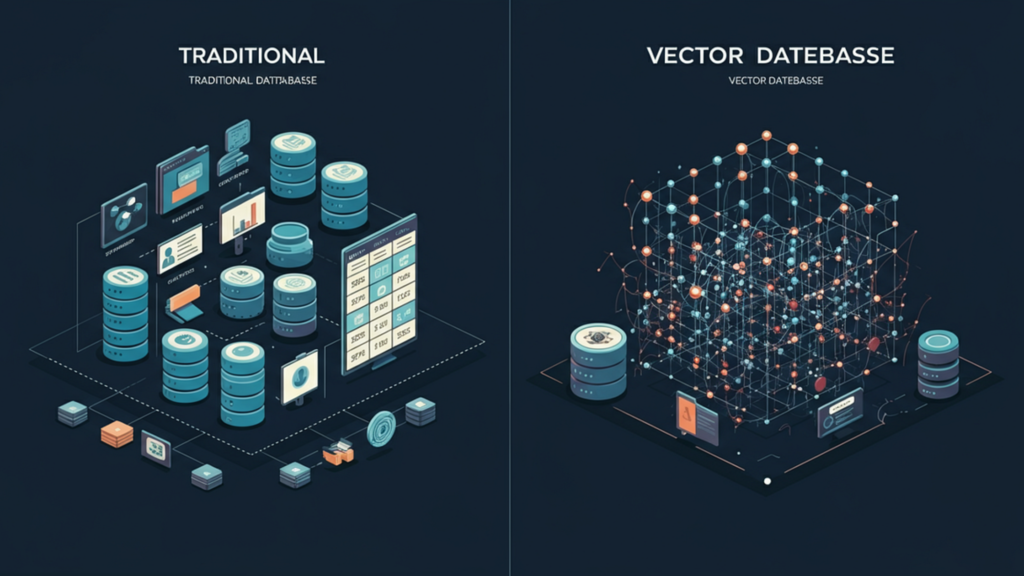
Unlike traditional databases that rely on exact keyword matching, vector databases focus on semantic similarity. This means they can identify information that is conceptually related, even when different words are used.
For example, if a user searches for “ways to reduce business expenses,” a vector database can also find content related to cost optimization, budget management, and operational efficiency because it understands the meaning behind the query.
Why Traditional Search Systems Are No Longer Enough
Traditional search systems have served businesses for many years. However, they often face limitations when handling large volumes of unstructured data.
Some common challenges include:
- Dependence on exact keyword matching
- Difficulty understanding user intent
- Poor handling of natural language queries
- Limited ability to recognize context
- Inconsistent search results
As organizations generate more documents, emails, reports, and knowledge assets, finding relevant information becomes increasingly difficult.
Modern AI applications require search systems that understand meaning rather than just words. This need has driven the adoption of vector databases.
How Vector Databases Work
Vector databases use machine learning models to convert data into vectors.
The process generally follows these steps:
Data Conversion
Documents, images, videos, and other content are transformed into vector embeddings using AI models.
Storage
The generated vectors are stored inside the vector database along with relevant metadata.
Query Processing
When a user enters a question or search query, the system converts the query into a vector.
Similarity Search
The database compares the query vector with stored vectors and identifies the closest matches.
Results Delivery
The most relevant information is returned to the user in real time.
This approach allows AI systems to understand context and provide more accurate results than traditional search methods.
The Role of Vector Databases in AI Search
Modern AI search systems depend on vector databases to deliver meaningful search experiences.
Semantic Search
Semantic search focuses on understanding the intent behind a query instead of matching keywords.
For example, a user searching for “customer retention strategies” may receive results discussing customer loyalty programs, customer engagement, and relationship management.
Because vector databases understand contextual relationships, they provide results that align more closely with user intent.
Improved Search Accuracy
Vector databases reduce irrelevant search results by identifying information that is genuinely related to the query.
As a result, employees spend less time searching and more time acting on information.
Faster Information Retrieval
Modern vector databases are optimized for handling millions or even billions of vectors efficiently.
Therefore, users can access relevant information within seconds, even when searching massive knowledge repositories.
Vector Databases and Retrieval-Augmented Generation (RAG)
One of the most important applications of vector databases is Retrieval-Augmented Generation (RAG).
RAG combines large language models with external knowledge sources to improve response quality.
Instead of relying only on pre-trained knowledge, the AI system retrieves current and relevant information before generating a response.
The process works as follows:
- A user submits a question.
- The query is converted into a vector.
- The vector database retrieves relevant documents.
- The AI model uses the retrieved information.
- A more accurate and context-aware response is generated.
This approach significantly improves the reliability and accuracy of AI-powered assistants.
Key Benefits of Vector Databases for Businesses
Better Knowledge Discovery
Employees can quickly find information across documents, knowledge bases, and enterprise systems.
Enhanced Customer Experiences
AI-powered support systems can provide faster and more relevant responses to customer inquiries.
Improved Productivity
Teams spend less time searching for information and more time focusing on valuable tasks.
Scalability
Vector databases can handle massive amounts of data while maintaining performance.
Smarter AI Applications
AI systems become more accurate, context-aware, and useful when powered by vector-based retrieval.
Common Use Cases of Vector Databases
Organizations across industries are using vector databases for various applications.
Enterprise Knowledge Management
Employees can instantly locate policies, procedures, training materials, and project documentation.
AI Chatbots and Virtual Assistants
Chatbots use vector databases to retrieve relevant information before responding to users.
Customer Support Systems
Support teams gain faster access to solutions and historical case information.
Recommendation Engines
Businesses can provide personalized recommendations based on user behavior and preferences.
Document Search Platforms
Organizations can search large document collections using natural language rather than exact keywords.
Why Vector Databases Are Essential for Enterprise AI
As businesses continue adopting AI technologies, access to accurate information becomes increasingly important.
Large language models alone cannot provide reliable answers for organization-specific knowledge. They require access to current and relevant data.
Vector databases bridge this gap by connecting AI systems with enterprise information sources.
As a result, businesses can build intelligent search solutions, AI assistants, and knowledge management platforms that deliver real value.
Conclusion
Vector databases have become a foundational technology for modern AI search and retrieval systems. They enable AI applications to understand context, identify semantic relationships, and deliver highly relevant information in real time.
Unlike traditional search systems, vector databases focus on meaning rather than simple keyword matching. This makes them ideal for enterprise search, knowledge management, customer support, and Retrieval-Augmented Generation (RAG) applications.
As organizations continue investing in AI, vector databases will play an increasingly important role in ensuring that AI systems can access and retrieve the right information when it matters most.
At Acquire TS, businesses can leverage advanced AI solutions, intelligent retrieval systems, and modern data architectures to unlock the full potential of enterprise AI and drive smarter decision-making across the organization.